
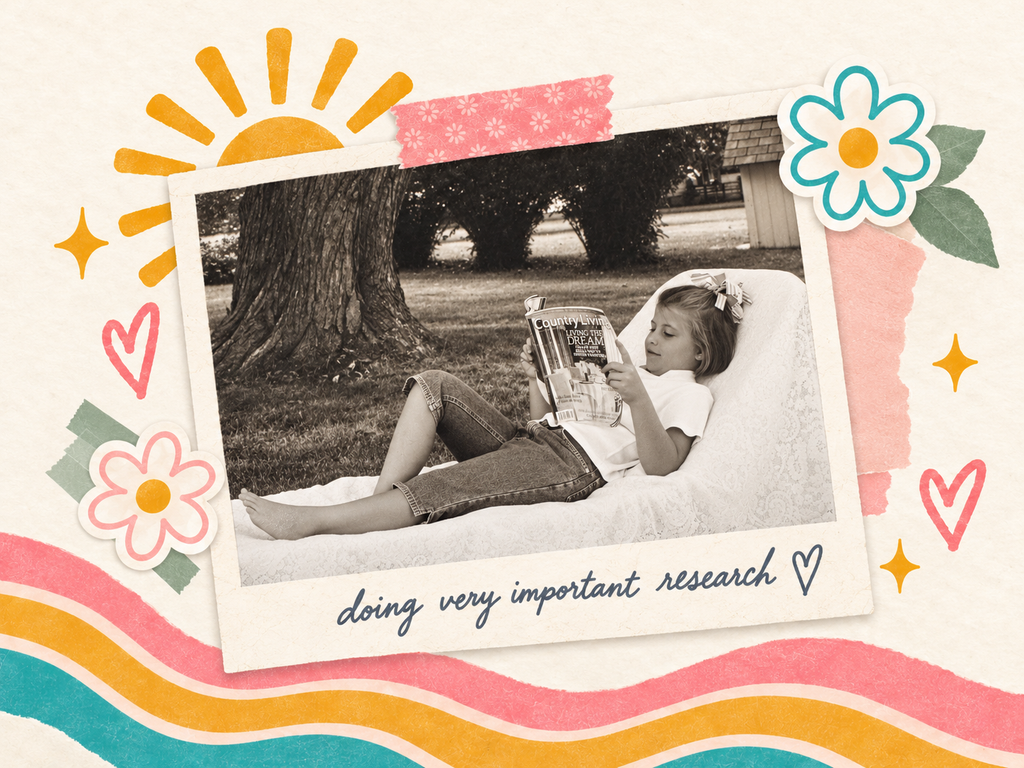
Our protagonist has always considered herself a creative person. Although, in retrospect, her relationship with actually making art has been a little complicated.
She has a Bachelor of Fine Arts degree in New Media, which makes a lot more sense when you understand that traditional fine art was never particularly her thing.
It was just so… slow.
She loved color, composition, photography, design, and the possibilities of making something beautiful. She just didn’t particularly enjoy spending six hours manually recreating something she could already see in her head.
She wanted to get to the good part. The part where all the pieces came together.
As it turns out, there might actually be a name for that.
A Brief History of Stealing Inspiration
As a child, our protagonist had bulletin boards in her bedroom. Multiple, actually. She would rearrange them every month to match the season, an upcoming holiday, or whatever theme she’d decided was appropriate at the time. Her bedroom door was covered in photographs, magazine clippings, and pictures she’d collected, arranged into an ever-changing collage.
She was constantly moving things around, adding something new, deciding something didn’t belong anymore, and starting again.
Apparently, she was art directing her bedroom before she knew art direction was a job.
Our protagonist loved being creative. She was just not very concerned with doing it correctly.
She liked putting things together, changing her mind, layering pieces, and seeing what happened. She didn’t always know what the finished page would look like. But she usually knew when something wasn’t right.
A distinction that would become increasingly inconvenient for everyone involved.
And this wasn’t limited to paper.
Fast forward a few decades, and she is now the kind of person who has planned her children’s birthday parties as though a production company has been hired. The decorations, invitations, food, colors, little details nobody asked for. She once spent 8 hours painting a treasure box for a pirate birthday party. Everything needs to feel like it belongs to the same idea.
She also had seven Christmas trees last year.
Seven.
No one requested this level of creative direction. Nevertheless, it was provided.
Some people decorate a room. She apparently needs to establish a visual identity for December.
The point is, she’s never been particularly attached to one medium. She loves the whole thing. The atmosphere, the story, the feeling, the details, and especially the moment when a collection of seemingly unrelated things start to make sense together.
And she usually has a pretty strong opinion about how that should happen.
The Pinterest Board Was Never the Point
Here’s the thing about her creativity. She’s not necessarily sitting around dreaming up brilliant original ideas from absolutely nowhere.
Usually, something catches her attention first. A photograph. A color. A scene in a movie. A beautiful room. Someone else’s artwork. Sometimes she doesn’t even know what she likes about it yet.
She just knows it makes her want to make something.
One little idea turns into another. She finds something else that reminds her of it, then something completely unrelated that somehow belongs with both of them. Eventually, all those little pieces start looking like the thing she’d been imagining.
Sometimes the original idea doesn’t even survive the process.
This continued into adulthood, where mood boards became a perfectly respectable professional activity and Pinterest arrived like a personal gift from the universe.
Unlimited bulletin boards. No pushpins. Incredible.
She collected images, quotes, typography, interiors, colors, photographs, and anything else that made her feel something. Sometimes for an actual project. Sometimes for no reason whatsoever.
But she wasn’t necessarily trying to recreate what she found.
She was trying to capture whatever it was about those things that made her stop and look in the first place.
And that’s an important distinction.
Her creativity isn’t always about inventing every individual piece. It’s about seeing what those pieces could become together. Knowing what belongs, what doesn’t, and how changing one little thing can change the entire feeling.
It’s having a point of view.
Which sounds lovely until you’ve moved the same element 47 times because it’s still just slightly wrong.
An Interesting Conversation About Originality
Of course, this raises an interesting question about creativity.
Because isn’t this what artists have always done?
We study other artists. We learn techniques. We collect references. We notice things we like and carry them into whatever we make next. Entire artistic movements have been built around people influencing one another.
Fashion comes back around. Movies borrow plots. Songs borrow sounds. Every romantic comedy seems to involve two people who could solve their problems by having one reasonably honest conversation.
And yet, somehow, we still love them.
Of course, there’s a difference between inspiration and copying. Taking someone’s actual work and presenting it as your own isn’t suddenly creative because you changed the font. Ownership matters. Attribution matters. The people whose work inspire us matter.
But creativity has never existed in complete isolation.
Our protagonist looks thoughtfully at her Pinterest boards containing approximately 4,000 images.
An interesting philosophical position for someone who has apparently been collecting evidence against herself since childhood.
And Then There Were Computers
The arrival of digital tools didn’t create her love of art direction. They just gave her another way to do it.
Photoshop, digital design, websites, and eventually AI offered something she absolutely loved: the ability to experiment without committing six hours to a decision she was probably going to change.
She could move something. Change a color. Try a different layout. Put it back. Change it again.
Save as final_final_ACTUALfinal.psd.
A beautiful system.
And this is probably why New Media appealed to her in the first place. It wasn’t about choosing technology over art. It was about finding tools that worked with the way she already thought.
She still loved creating things she could actually touch. Decorating, arranging, making things for her kids, putting together elaborate little worlds for absolutely no necessary reason.
Digital was never the whole story.
It was just one more place to make the thing in her head exist in real life.
Naturally, this introduced an entirely new problem.
Apparently, using technology to make art wasn’t quite the same as making real art.
And then AI came along.
Oh, wonderful.
Now we’re really cheating. *insert eyeroll*
The Plot Thickens…
All notes